
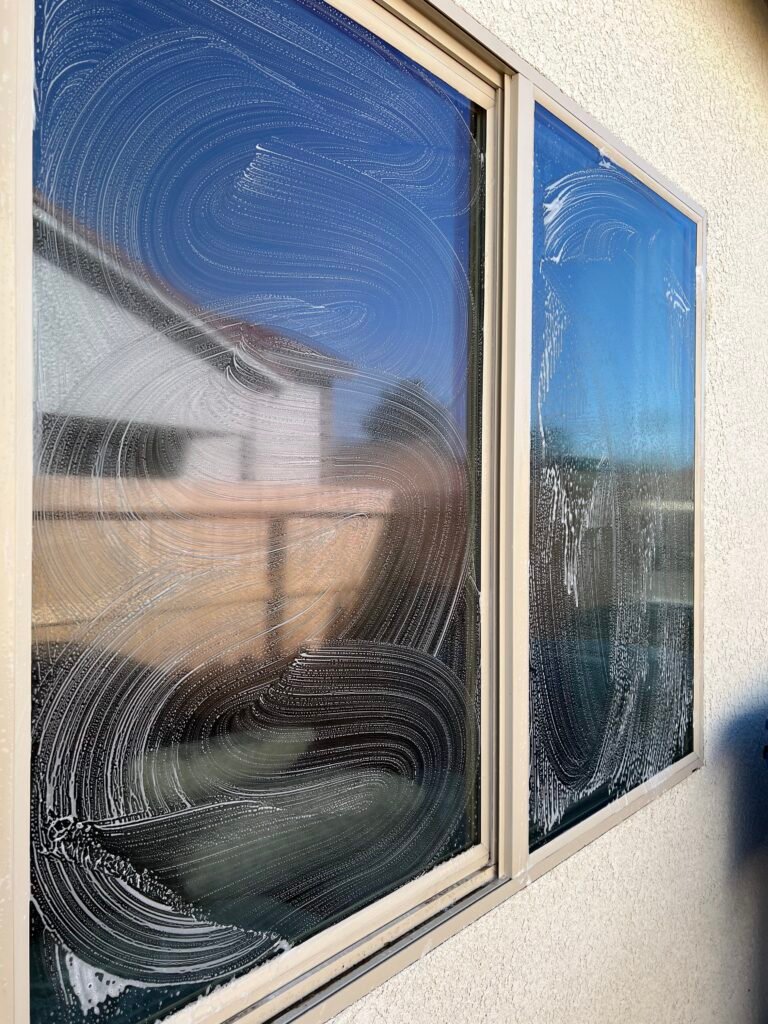
If the bottom half of your windows look cloudy, spotted or chalky while the top half looks fine, your sprinklers are almost certainly to blame. It’s one of the most common window problems we see in Fresno and Clovis, and one of the most frustrating, because regular glass cleaner barely touches it.
Sliding glass doors, low bedroom windows and any glass facing a lawn or flower bed tend to get hit the hardest. If you see a clear line where the spotting stops, that’s usually exactly how high your sprinkler spray reaches.
Here’s what’s going on: sprinkler water contains dissolved minerals, mainly calcium and magnesium. When that water lands on your windows and evaporates, the water disappears but the minerals stay behind as small white spots. Every time the sprinklers run, another layer gets added. Over weeks and months, those spots build into a hazy crust that can be tough to remove. The fix is a combination of removing the existing deposits the right way and stopping the overspray at the source.
Why hard water spots are so common in the Valley
Water in many parts of the Central Valley naturally carries dissolved minerals, picked up as it moves through soil and rock. That’s normal and not a problem for watering your lawn, but it does show up on glass. A few local conditions make it worse:
- Lots of irrigation: Valley lawns and landscaping need regular watering through our long, dry season, so sprinklers run often.
- Heat and sun: Hot weather evaporates water off glass quickly, leaving minerals behind before they have a chance to run off.
- Sprinklers near the house: Spray heads in narrow side yards and flower beds often hit walls and windows directly.
- Wind and drift: Even well-aimed sprinklers can drift onto windows on a breezy day.
- Dust: Valley dust sticks to wet glass and mixes in with the mineral deposits, making them look even worse.
Why you shouldn’t wait to deal with them
Fresh water spots are mostly sitting on top of the glass. But when minerals are left on glass for a long time, especially under strong sun, they can bond more tightly to the surface. In severe cases, long-term buildup can etch the glass, leaving permanent marks that no amount of cleaning will fully remove.
That’s why it’s worth taking care of water spots early, and fixing the cause, instead of letting layer after layer build up through the summer.
How to remove light hard water spots yourself
If the spots are fairly new and light, you can often remove them with a little patience and some gentle household supplies. Always test a small corner first, and work on cool glass, not in direct afternoon sun.
- Rinse the window with plain water to remove loose dust and grit, so you don’t grind it into the glass.
- Mix a solution of white vinegar and water in a spray bottle. The mild acid helps loosen mineral deposits.
- Spray the spotted area and let it sit for a few minutes, but don’t let it dry. Re-spray if needed.
- Gently wipe with a soft microfiber cloth or non-scratch sponge.
- Rinse well with clean water, then squeegee or dry with a clean microfiber cloth to avoid leaving new spots.
- Protect nearby surfaces. Wipe up any drips on window frames, stone sills or plants.
Avoid steel wool, abrasive scrubbing pads, scouring powders and razor blades. These can easily scratch glass, and many modern windows use tempered or coated glass that’s especially easy to damage. A scratched window is a much bigger problem than a spotted one.
Turn your sprinklers off for a day or two before you clean the windows, and keep them off until the glass is dry. Otherwise you can end up with fresh spots on your freshly cleaned windows the very next morning.
How to stop sprinkler spots from coming back
Removing the spots is only half the job. If the sprinklers keep hitting the glass, you’ll be right back where you started in a few weeks. Here are some simple ways to prevent new spots:
- Walk your yard while the sprinklers run and note every head that hits the house, windows or sliding doors.
- Adjust spray heads so they aim at the lawn and beds, not the walls. Many heads can be turned or have their spray arc adjusted by hand.
- Swap problem heads for lower-angle nozzles or shorter-throw nozzles in tight spaces near the house.
- Consider drip irrigation for flower beds right next to the home. It waters plants at the roots without spraying the walls.
- Check after landscaping work or mowing, since heads often get bumped out of position.
- Avoid running sprinklers on windy days if your system allows it.
Fixing overspray also helps your stucco and paint. Constant water on walls can leave stains and mineral marks there too. And it saves water, since every drop that lands on your house is a drop your lawn didn’t get.
Screens can collect mineral spots and dust as well. If your windows are behind screens that get sprayed, washing the screens at the same time keeps them from dripping dirty, mineral-heavy water back onto clean glass.
When to call a professional
It’s a good idea to call a pro if the spots don’t budge after a gentle vinegar cleaning, if the haze covers most of the window, if you’re dealing with second-story glass, or if you’re not sure what kind of glass or coatings your windows have. Professional window cleaners have tools and techniques for removing mineral deposits more safely than a DIY scrub.
Light to moderate water spotting usually comes off during a regular cleaning. Heavy, baked-on mineral deposits can take extra work. At Ducky’s, we’ll take a look and give you an honest idea of what to expect before we start. Regular window cleanings every few months also keep spots from building up to that point in the first place.
Need help? Call Ducky’s
Ducky’s Exterior Cleaning helps homeowners across Fresno, Clovis and the Central Valley get spotted windows clear again, with frames, sills, tracks and screens cleaned too. We’re licensed and insured, open 7 days a week from 5am to 10pm, and every job comes with our 100% satisfaction guarantee. Call (559) 492-0155 for a free estimate.